

Fulbright
Fulbright U.S. Student Program
What if your next step after graduation took you across the globe?
The Fulbright U.S. Student Program offers graduating seniors and alumni the opportunity to spend a year abroad conducting independent research, pursuing graduate study, or serving as an English Teaching Assistant in one of more than 140 countries worldwide. As a Fulbright participant, you’ll gain invaluable international experience, advance your academic and professional goals, and serve as a cultural ambassador, building meaningful connections and fostering mutual understanding between the United States and communities around the world.
A Fulbright experience can be transformative … expanding your perspective, strengthening your professional network, developing cross-cultural communication skills, and preparing you for future careers in academia, research, public service, education, international affairs, and beyond.
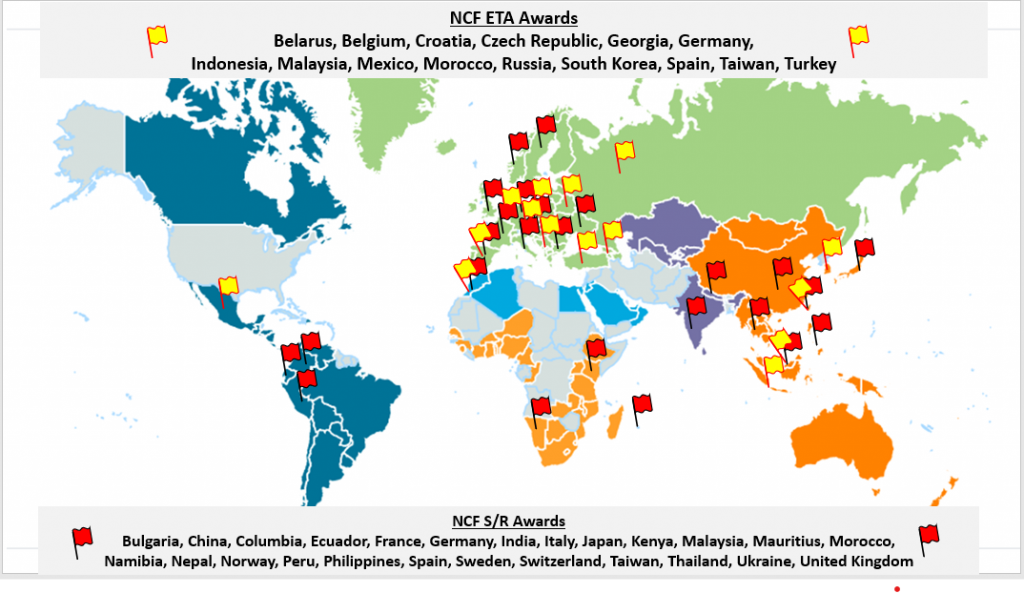
New College of Florida has a long tradition of Fulbright success. Since 1968, more than 90 New College students and alumni have received Fulbright U.S. Student Awards to study, conduct research, or teach abroad in over 36 countries. As one of Florida’s leading producers of Fulbright recipients, New College continues to empower students to pursue ambitious goals and make a global impact.
Ready to take your education beyond borders? The Career Center can help you explore Fulbright opportunities, identify the right program, and develop a competitive application.
Building on New College’s emphasis on close student-faculty interaction and independent research, a dedicated team of faculty and advisors will guide and support you throughout the application process.
Here are some past Banyan Fulbrighter projects:
Fulbright to Sweden to study resettled Iraqi refugees — As the daughter of a U.S. Foreign Service family, Silvia Ulloa spent her childhood in four countries. The family lived in Saudi Arabia when the second Iraq War began and had to be evacuated twice. During her New College work in anthropology and gender studies, she traveled to Jordan to work with agencies that assist Iraqi refugees.
Fulbright for history and music research at the University of Heidelberg in Germany — At New College, Amelia Nordin was teaching assistant in music theory, a pianist and accompanist, composed two pieces performed in concert series, and interned with Sarasota Opera. Her studies have been in a field known as musicology, in which disciplines such as history, philosophy, psychology and even mathematics are used to analyze music.
Fulbright for cancer research in Germany — At New College, Christopher Mulholland focused his work in biology with several independent study projects on epigenetics and molecular biology. He conducted his senior thesis research work at the Lovelace Respiratory Research Institute in Albuquerque, N.M., where he took on the challenge of identifying regions of DNA methylation within single cancer cells in culture.
Fulbright to study giraffe populations in Namibia — Katharine Dean volunteered at the Lemur Conservation Foundation in nearby Myakka City where she learned about animal behavior and husbandry. She later volunteered as a research assistant at Loskop Dam Nature Reserve in South Africa and extended her stay to collect data for her senior thesis on “The Effects of Feeding Behavior on Parasitic Infections in Wild Vervet Monkeys.”
Fulbright to teach English in Taiwan — In her second year at New College, Jennifer Lieb was one of only 50 women worldwide to be accepted to attend an international conference in Dubai focused on promoting cultural and academic exchange. While conducting research for her senior thesis in the Philippines, she tutored a 13-year-old boy in English grammar and geometry, where she honed teaching skills, and he completed his first three-page book report entirely in English.
Fulbright to study black birds’ sleep patterns in Germany — In his first year at New College, Ryan Tisdale and a group of students drove across ice sheets in northern Finland above the Arctic Circle to photograph the aurora borealis and evidence of climate change. The next year, he took an intensive one-month German language course in Ulm, Germany, during the January Interterm and again in summer. His experience conducting field research on the roles wildfires play in driving plant successional patterns in Alaskan boreal forests crystallized his desire to become an international research biologist.
Contact Fellowships and Scholarships ([email protected]) with any questions!