
Progressives freaked after conservatives took over New College of Florida. Three years later, it’s doing great.
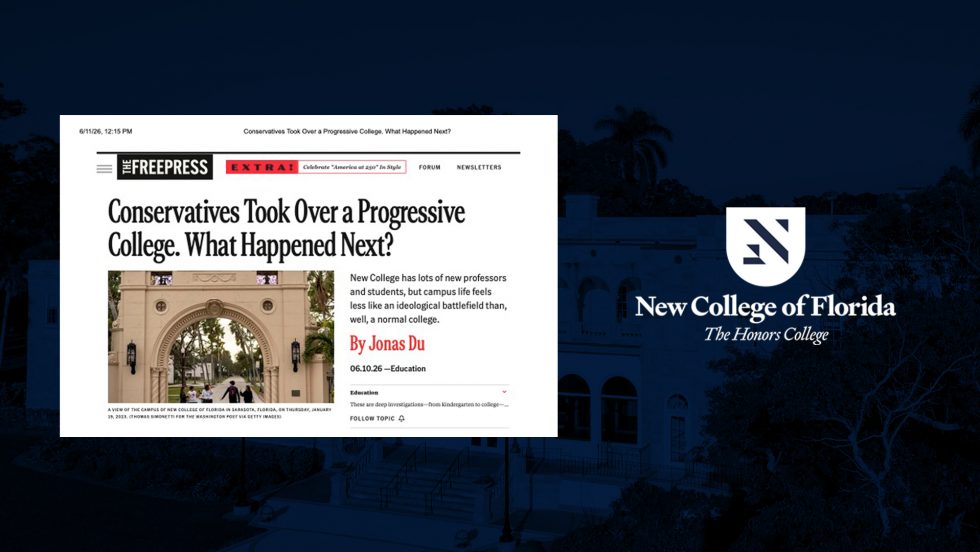
New College has lots of new professors and students, but campus life feels less like an ideological battlefield than, well, a normal college.
SARASOTA, Florida — Jones Hogsed knew all about the political firestorm at New College of Florida when he was trying to decide whether to enroll here two years ago.
The public liberal-arts school long had a reputation for being far left, with an intellectual culture centered around identity politics. New College also had just been upended by Republican governor Ron DeSantis, whose supporters wanted to shape it into the “Hillsdale of the South,” a nod to the proudly conservative college in Michigan.
Hogsed was worried about both extremes, including what he described as the false premise that “serious academia is primarily a ‘conservative’ effort.” He came to New College anyway—and just finished his sophomore year. What he found turned out to be very different.
“It’s really not a battlefield of political views,” said Hogsed, who is from Orlando and studies literature and philosophy. He sees “divides in a few different ways,” but “none of them are political.”
This college of fewer than 1,000 students has been the subject of countless op-eds and think pieces since DeSantis packed the board overseeing New College with conservative allies in 2023. Depending on your point of view, it is either a blueprint for how to save American higher education from progressive ideological capture or a foretaste of where the Trump administration’s crackdown on academia will lead.
DeSantis repeatedly called New College a “Marxist commune,” while John Oliver dedicated the latest episode of his HBO late-night show to a takedown of the college’s new leaders, comparing them to Nazis. “It is the exact sort of smash and grab we’re seeing in so many places right now. . . ideologues capturing something that they hate, claiming that they want to fix it, and then destroying it instead,” Oliver said.
Neither version of events matches the reality I found on a recent trip to the school’s Sarasota campus, where enrollment has increased every year since 2023 and is now at more than 900 students. While there certainly are more conservative faculty members and students than before, what I saw showed that many of New College’s strongest traditions are largely untouched.
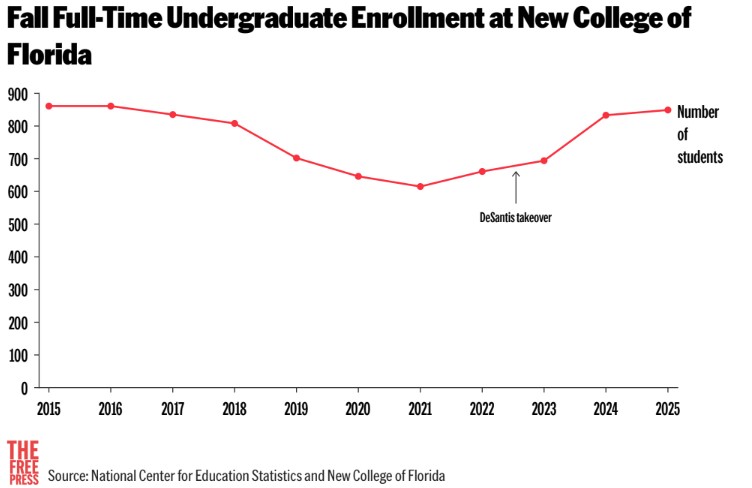
Source: National Center for Education Statistics and New College of Florida
For example, New College still relies on “narrative evaluations” of students written by their professors, though grades are now used, too, partly to satisfy graduate schools. Students still complete an independent study project before the spring semester and can participate in one-on-one tutorials with professors, though all freshmen must now take one half-semester course about Homer’s Odyssey and another about mathematics and natural sciences.
“What I’m proud about over the last three years is that in addition to many, many new ideas, new projects, new policies, new educational strategies. . . New College remains the college it was in terms of that model of experimental learning and experiential learning,” said provost David Rohrbacher, who has taught here since 2000.
The professors who spoke to me said that new president Richard Corcoran’s administration does not police what they teach, though some students said they have noticed fewer course offerings about feminism and race. “This semester, I wanted to take a class on Hannah Arendt, and they don’t offer that, so I just created it myself with this tutorial,” said Alexandra Levy, a junior. “If you wanted to take an African American literature class, you’d probably have to create a tutorial, and I don’t know who would sponsor it.”
New College also hardly looks like a place being “destroyed,” as Oliver claimed. On the balmy Wednesday when I walked around the lush, palm tree–lined campus, I saw students playing pickup soccer and beach volleyball on fields overlooking Sarasota Bay. Women in elegant dresses posed for pictures with the sun setting over the Gulf of Mexico as a backdrop. Students dined and studied on the patio outside the school’s I.M. Pei–designed dorms.
DeSantis and his allies argued that New College, founded in 1960 to “free both students and faculty from the limits of lock-step curriculum,” was failing intellectually, its buildings and dorms in disrepair and badly in need of a shake-up. A 2019 report commissioned by New College found that many admitted students associated its culture with “druggies,” “weirdos,” and political correctness. The report said that the student body as a whole had “low levels of satisfaction” with New College and that “a high percentage” had “considered leaving the college before graduation.”
The pronouncement by DeSantis’s chief of staff that New College should become “Florida’s classical college, more along the lines of a Hillsdale of the South,” caused panic among those who wanted to keep New College just as it was. Over 40 percent of its 105 faculty members left by the fall of 2023, though the college says that about three-quarters of the departures were previously planned retirements or sabbaticals. At least a dozen more left within the next year. Since then, New College has hired about 45 new professors, many from elite institutions, increasing the overall size of its faculty to 125.
“Most of the ideological warriors have left,” Corcoran told me. “They’ve left because they don’t want balance. . . . The people we’ve been hiring are a who’s who of faculty in the history of the college.”
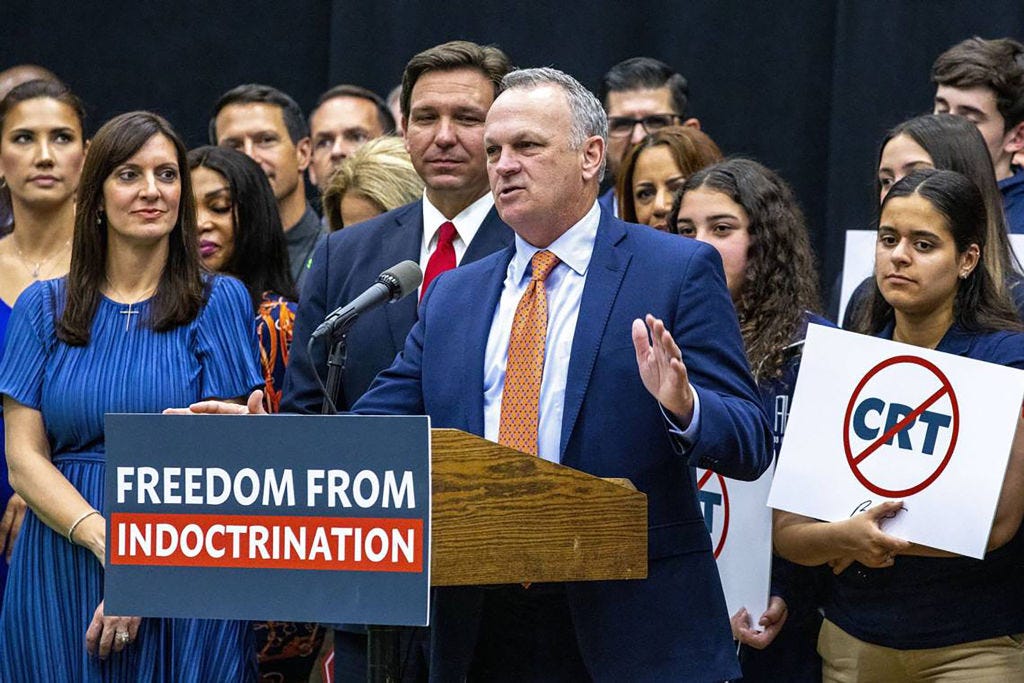
Corcoran, the Republican former speaker of the Florida House of Representatives and state education commissioner, also insisted that the Hillsdale comparison was solely about emulating its free speech, civil discourse, and selectivity in admissions, not about turning New College explicitly conservative and Christian. “The great liberal-arts schools that are not indoctrinating, that have great [test] scores and get great students—yeah, that would be who we’d like to be,” he said.
The new New College has broadened its offerings of Great Books–based courses called “Enduring Human Questions” to fulfill a new state requirement for public colleges that includes teaching the Western canon. It also commissioned a statue of Charlie Kirk, which Corcoran denied is about politics and said symbolizes the commitment to “free speech, academic freedom, and civil discourse.” And it shut down the gender-studies center and threw away some of its books.
Students can no longer earn a degree in gender studies because “it’s not a real discipline,” Corcoran said, adding that the subject “should be taught” in other classes as a component of intellectual history.
When I asked if he believes balance means equal percentages of Republicans and Democrats, Corcoran said no. “In an ideal world, it wouldn’t matter, because whoever you hired was going to teach the heck out of their discipline and not indoctrinate.” Faculty job interviews do not include questions about politics, Corcoran told me, but he makes sure that potential hires aren’t “anti–free speech” and “anti–academic freedom.”
David Mikics, an English professor who arrived in 2024 from the University of Houston, said that New College is not hiring people “who want to turn the classroom into a place for political activism” and that “people who are more leftist ideology–driven probably wouldn’t be applying here in any case.”
The overhaul has been expensive. Operating expenses at New College were over $83,000 per student in fiscal 2024, the highest of any public college or university in Florida and nearly four times the average. The high costs include renovations and new facilities across the campus—an “apocalyptic sandlot” when Corcoran arrived, he said—ranging from a baseball stadium to temporary housing after a mold infestation took out freshmen dorms.
Over 25 percent of the student body chose not to return for the fall semester in 2023. About three dozen accepted a transfer offer from Hampshire College, a freewheeling liberal-arts college in Massachusetts. Hampshire announced in April that it will close its doors when this fall’s semester ends.
Some of the liberal students who stayed at New College said they feel like the supposed political divide on campus has been exaggerated by the media. No student substantiated the narrative that the college is in the grip of a right-wing censorship apparatus, though there were complaints about a crackdown on “balcony culture.”
Students used to hang flags and posters from dorm balconies and windows, but the new administration said it posed a fire hazard. Drawing with chalk on a pedestrian overpass also was prohibited. And editors of a campus newspaper and literary magazine told me that they began to publish independently because they believed that the administration wanted to oversee them.
“We don’t censor anything,” Corcoran said in response, denying that there is or ever will be a policy policing what students publish. New College has always required oversight by faculty advisers for student clubs, including publications, he added, saying that he hoped those advisers would “teach them proper journalism” that is “fair and balanced.”
The most divisive change at New College is an influx of over 400 student athletes, many of them recruited and awarded scholarships to play on one of more than 15 varsity sports teams, which the college never had before. The move is part of a strategy to broaden racial and gender diversity on campus, not to pad enrollment.
The athletes are easy to spot in clothes branded with the school’s new mascot, the Mighty Banyan, a tree flexing its muscles. It replaced the Null Set, which was based on a mathematical notation and symbolic of New College’s proud quirkiness. Even the new mascot was controversial, with a retired teacher writing in the Sarasota Herald-Tribune that the tree “has been anthropomorphized to resemble an angry, threatening brown individual.”
Other students told me academic rigor has slipped now that there are almost as many athletes on campus as nonathletes.
“It’s like I’m back in middle school,” said Dania Hefley, a senior. “The biggest change is that I can notice students don’t want to be here, students don’t want to learn.” According to Rohrbacher, the provost, recruited athletes have had higher grade point averages than other admitted students every year since the takeover, including 2023.
“I think maybe that’s a culture shock to some of the previous students on campus,” said Jackson Dawson, a junior on the basketball team who also leads the 100-student Turning Point USA chapter. “But they’re okay with us. We all get along. We sit in the same lunch cafeteria. It’s not like there’s. . . a border wall between us.”
“Every year, it gets better and better,” Dawson added.
Minh Huynh, another senior, said it has become less common for conservative students to be ostracized for their views because there are a lot more of those students. In the past, they “would realize they don’t really have any place at the school,” Huynh said.
In October, New College said it wanted to be the first college or university to sign the Trump administration’s “Compact for Academic Excellence in Higher Education,” which promises preferential treatment for federal funding in exchange for eliminating “discriminatory admissions processes,” freezing tuition for American students, and ensuring “rigorous, good faith, empirical assessment of a broad spectrum of viewpoints,” among other requirements. Some major colleges denounced the proposal as an unlawful and unconstitutional infringement on speech and academic freedom.
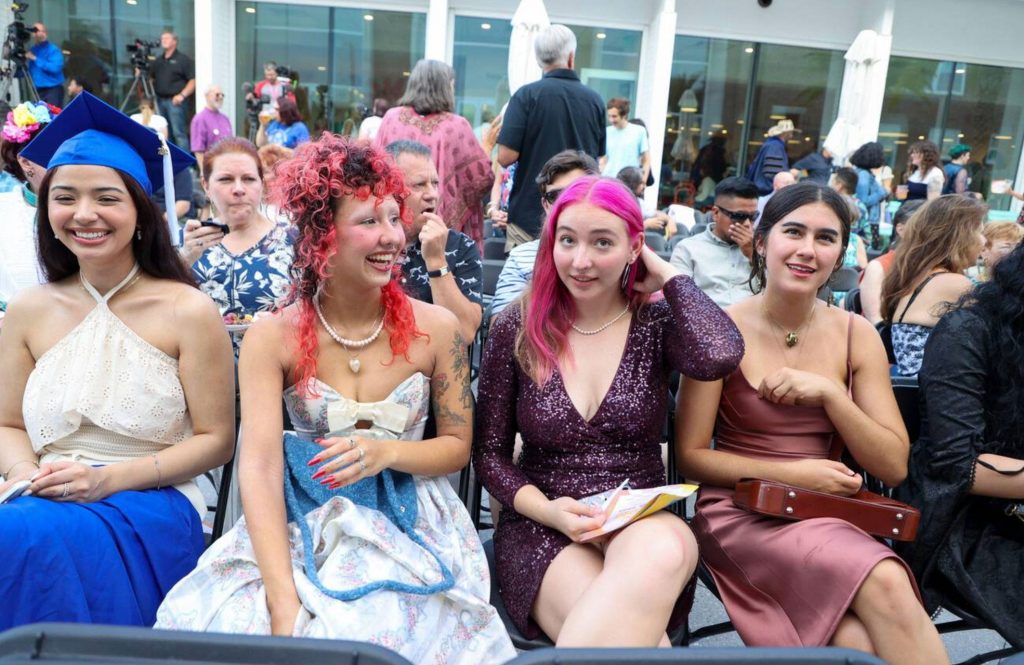
It was another sign of how much New College has changed. So was last month’s commencement ceremony, where one speaker invoked Ronald Reagan, freedom, and the Constitution before telling graduates: “Protect liberty. Defend open inquiry. Respect the dignity of others.”
During my visit, I asked Corcoran if he believed there is still a place in higher education for students who want the old New College, an ideological and educational experiment that endured for over 60 years. “One hundred percent,” he said. “But not with public tax dollars. You want to use public tax dollars, it should appeal to the masses.”
Note: This article was originally posted by The Free Press, and the original can be found by visiting their website here: https://www.thefp.com/p/new-college-florida-desantis-higher-education
Jonas Du
Jonas Du is a fellow at The Free Press based in Washington, D.C. Jonas began at The Free Press in 2024 as an intern while he was a student at Columbia University, where he was founder and editor-in-chief of the Columbia Sundial.