

Master of Education in Educational Leadership
Lead with Purpose.
Inspire Excellence.
Transform Schools.
A two-year, 36-credit M.Ed. that blends classical liberal arts with modern leadership science, preparing future principals and district leaders to drive learning outcomes and culture.
Program at a Glance
Credits: 36
Cohort: 15-20 (Year 1)
Format: Face to Face
About M.Ed. Leadership Program
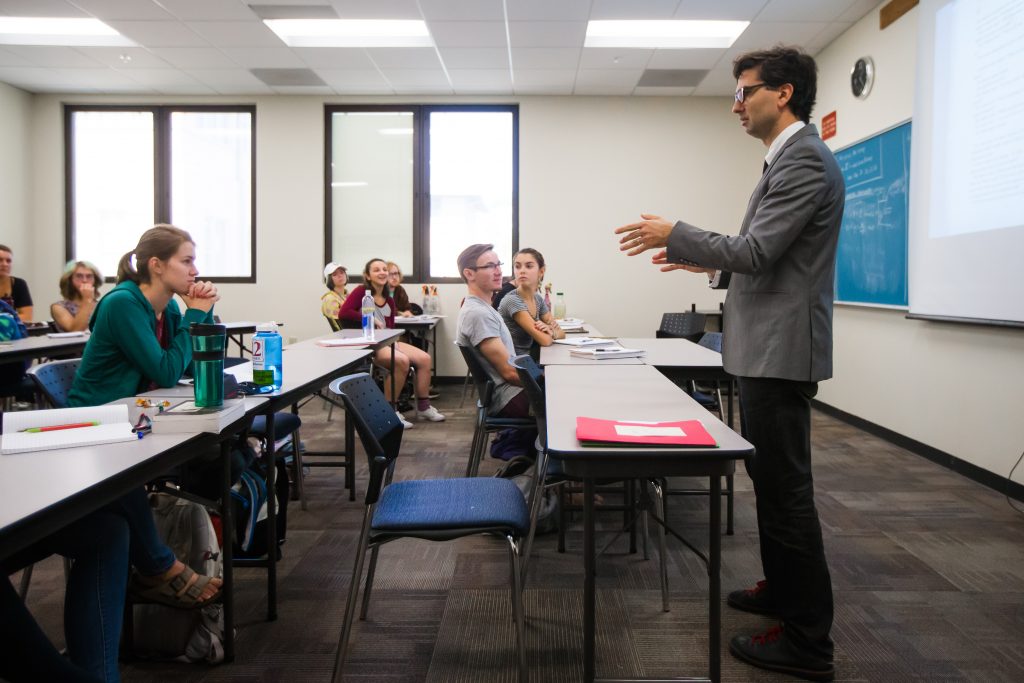
The New College M.Ed. in Educational Leadership Program is built for bold thinkers and reformers ready to tackle today’s most pressing challenges in education. This program prepares graduates to step into leadership roles with the vision, skills, and integrity needed to transform schools and improve outcomes for students, families, and communities.
Unlike compliance-driven programs that maintain the status quo, the New College approach develops leaders with the true end of education in mind. Master’s recipients lead schools that promote intellectual and character development, close achievement gaps, and create engaging learning environments. Here, education reformers will find a home for innovation, collaboration, and leadership grounded in research and real-world best practice.
Why Choose NCF for Educational Leadership?
Classical liberal arts meets modern leadership science, designed explicitly for future principals and high-impact school leaders.

Distinctive Philosophy
Grounded in Aristotle, Hirsch, and cognitive science, pairing timeless wisdom with proven practice.

Real-World Practice
Practicum in Sarasota/Manatee districts and two capstone experiences.

Outcomes-Driven
Master data cycles, feedback, and coaching models that raise student achievement.

Network & Mentorship
Build bonds with Florida leaders, advisory council mentors, and your cohort.
CAREER OUTCOMES
Principal & Assistant Principal
Lead a school. Inspire teachers. Empower students.
As a principal or assistant principal, you’ll shape the vision, culture, and success of an entire learning community.

Instructional Coordinator
Design the future of learning.
Instructional Coordinators shape curriculum, support teachers, and bring innovative teaching strategies to life in every classroom.

District Administration
Lead change across an entire school system.
District administrators develop strategy, guide school leaders, and implement programs that strengthen teaching and learning across multiple schools.

Director/Supervisor
Lead with vision. Drive educational excellence.
Directors and Supervisors oversee programs, mentor leaders, and shape policies that elevate teaching and learning across entire districts.

Teacher/College Professor
Inspire minds. Shape the future.
Teachers and professors ignite curiosity, empower students to think critically, and make a lasting impact through education.

Education Reform/Policy
Shape the future of education.
Professionals in Education Reform and Policy analyze data, design initiatives, and advocate for policies that strengthen education systems and expand opportunity.


Admissions Information
We seek enthusiastic leaders with a strong work ethic, a growth mindset, and a commitment to student outcomes and character development.
Eligibility & Materials
- Earned a bachelor’s degree from a regionally accredited U.S. institution or a comparable degree from an international institution with a minimum 3.0 (on a 4.0 scale) grade point average.
- Transcript: Official or unofficial transcripts will be reviewed
- Resume/CV: Ideal candidates demonstrate two years of full-time PK-12 classroom teaching experience. If you have not taught, your resume should demonstrate interest/experience working with children and/or teaching.
- Letter of recommendation from a professor or supervisor (ideally a principal) in a teaching role
- Essay/Statement of Purpose: In 3 pages or less, explain why you are interested in earning a Master’s in Education Leadership at the New College. Present clear evidence of your expertise and leadership potential and how you will contribute to the cohort.
- English Proficiency Scores (if applicable)
- Optional Additional letters of recommendation (up to 3 in total)
- GRE scores (preferred but optional)
Key Dates
– Applications open: September 22nd, 2026
– Final deadline: June 15th, 2027
– Start term: August 16th, 2027
Cost & Aid
Transparent tuition at an affordable rate! Total Program: 36 credits
Estimate Your Tuition
Per Credit
$474.33
Total Credits
36
Estimated Program Total
$17,075.88
Per Credit
$1,169.47
Total Credits
36
Estimated Program Total
$42,100.92
Ways to Finance
Transformative Coursework That Prepares Leaders:
YEAR 1: EXCELLENCE IN EXECUTIVE LEADERSHIP
Year 1- Fall
Click a course below for more details
Course 1
Champion Instruction- Pedagogical Methods that Lead to Outlier Outcomes
EDA 5508
Course 1: Champion Instruction- Pedagogical Methods that Lead to Outlier Outcomes
Course Description: Develop the skills to model and identify excellent outcome-driven instructional practices and teach them to teachers. Coursework includes best practices in developing a strong classroom environment and pedagogical techniques that support the mastery of rigorous learning objectives.
Sample Reading List:
- Teach Like a Champion 3.0: 63 Techniques that Put Students on the Path to College by Doug Lemov
- Orator’s Education by Quintilian
Course 2
Philosophical and Historical Foundations of Education
EDF 5520
Course 2: Philosophical and Historical Foundations of Education
Course Description: This course examines the philosophical and historical foundations of education, with particular attention to the development of education in the United States. Students explore classical liberal arts traditions, the role of education in a democratic society, and major educational philosophies that inform the pursuit of excellence in learning, teaching, and leading.
Sample Reading List:
- The Great Tradition: Classic Readings on What It Means to Be an Educated Human Being Edited by Richard Gamble
- Abolition of Man by C. S. Lewis
- Democracy and Education by John Dewey
- The Paideia Proposal by Mortimer Adler
Course 3
Leadership: Emotional Intelligence, Presence, and Communication
EDA 5503
Course 3: Leadership: Emotional Intelligence, Presence, and Communication
Course Description: Develop deep awareness of talents, strengths, and growth areas as leaders and how to leverage these for high-impact communication and communication through the use of working style/talent inventory and one-on-one coaching to create a development plan.
Sample Reading List:
- Crucial Conversations by Kerry Patterson, Joseph Grenny, Ron McMillan, and Al Switzler
- Made to Stick by Chip Heath and Dan Heath
- King Lear by William Shakespeare
Year 1 – Spring
Click a course below for more details
Course 4
Philosophy of Education
EDF 5545
4: Philosophy of Education
Course Description: Develop a deep understanding of the purpose of education, rigorous K-12 content, research on content-specific pedagogy and assessment, and leadership best practices to support excellence in this realm.
Sample Reading List:
- – Nicomachean Ethics, Aristotle
- – The Talented Tenth, W.E.B. Du Bois
- – The Abolition of Man, C.S. Lewis
- – The New Art and Science of Teaching, Robert Marzano
- – Data-Driven Instruction, Paul Bambrick
- – Why Don’t Students Like School? Daniel Willingham
- – The Knowledge Deficit, E.D. Hirsch
Course 5
Instructional Leadership as a Liberal Art
EDF 5544
Course 5: Instructional Leadership as a Liberal Art
Course Description: Understanding leadership as a liberal art helps us prepare to lead schools and teams of teachers. Learn models of effective coaching to deliver high-quality, high-leverage, bite-sized feedback and have teachers plan and practice implementing the new skill or technique. Add the use of video for teaching, coaching, and leadership coaching.
Sample Reading List:
- – Proverbs
- – Moralia, Plutarch
- – Meditations, Marcus Aurelius
- – Teaching the Work of Management, Peter Drucker (?????)
- – Get Better Faster 2.0: A 90-Day Plan for Coaching New Teachers, Paul Bambrick-Santoyo
- – Leadership is an Art, Max De Pree
Course 6
Science of Learning, Cognitive Science, Positive Psychology
EDP 5216
Course 6: Science of Learning, Cognitive Science, Positive Psychology
Course Description: Develop deep and practical mastery of key science related to the development of early and late literacy skills, conceptual understandings, and fluency in mathematics, developing a culture of error and motivation with a growth mindset.
- – Elements, Euclid
- – Mathematics for Human Flourishing, Francis Su
- – Grit, Angela Duckworth
- – Proust and the Squid, Maryanne Wolf
- – Language at the Speed of Sight, Mark Seidenberg
- – iGen, Jean Twenge
- – Why Don’t Students Like School? Daniel Willingham
- – Mindset, Carol Dweck
- – Atomic Habits, James Clear
YEAR 2: EXCELLENCE IN EXECUTIVE LEADERSHIP
Year 2 – Fall
Click a course below for more details
Course 7
Educational Leadership: Vision, Practice, and Character
EDA 5192
Course 7: Philosophy of Educational Leadership
Course Description: Apply best practices in leading and managing high-performing teams and leadership teams through school-based case studies. Develop a vision and plan for performance goals, structure, leadership, and overall school environment to meet the goals. Build mastery around crisis management skills.
Sample Reading List:
- – Politics, Aristotle
- – Letters from a Stoic, Seneca
- – Leverage Leadership 2.0, Paul Bambrick-Santoyo
- – First, Break All the Rules: What the World’s Greatest Managers Do Differently, Marcus Buckingham and Curt Coffman
- – Better: Surgeon’s Notes on Performance, Atul Gawande
- – The Five Dysfunctions of a Team, Patrick Lencioni
Course 8
Data-Driven Instruction
EDA 5423
Course 8: Data-Driven Instruction
Course Description: Analyze and identify trends in achievement data and student work samples across grades and disciplines to create strategic interventions to improve learning outcomes. Includes analysis of the Florida assessments and leadership moves to reach exemplary status as evaluated by the state.
Sample Reading List:
- – The Structure of Scientific Revolutions, Thomas Khun
- – Leisure: The Basis of Culture, Josef Pieper
- – Between Past and Future, Hannah Arendt
- – Data-Driven Instruction, Paul Bambrick-Santoyo
- – Why Don’t Students Like School? Daniel Willingham
Course 9
Excellence in Teaching Capstone
EDG 5940
Course 9: Excellence in Teaching Capstone
Course Description: Develop proficiency in planning and teaching core content areas through teaching class(es) at local schools with high-touch instructional coaching. Daily lesson practice, real-time feedback, and self-analysis using video footage will support growth.
Year 2 – Spring
Click a course below for more details
Course 10
Talent Recruitment, Selection, Onboarding, and Retention
EDA 5219
Course 10: Talent Recruitment, Selection, Onboarding, and Retention
Course Description: Learn from top schools/organizations how to recruit, select, and onboard for key competencies and mission alignment. Develop an effective plan for staff retention and longevity.
Sample Reading List:
- – Republic, Plato
- – Talent Code, Daniel Coyle
- – Who: The A Method for Hiring, Randy Street
Course 11
Leading Special Education with High Expectations and Innovative Support
EDA 5191
Course 11: Leading Special Education with High Expectations and Innovative Support
Course Description: Understanding the legal frameworks for serving students with individual education plans and moving beyond just meeting compliance to support strong growth and outcomes for these learners.
Sample Reading List:
- – Exceptional Learners: An Introduction to Special Education, Daniel Hallihan, James Kauffman
Course 12
Leading in Florida Metrics, Law, and Budgeting
EDA 5231
Course 12: Leading in Florida Metrics, Law, and Budgeting
Course Description: A case study-focused course that puts MEDL candidates into realistic scenarios and helps them build and adopt strong intellectual frameworks for strategic, proactive, and reactive decisions related to these areas.
Sample Reading List:
- – TBD
Course 13
Excellence in Instructional Leadership Capstone
EDA 6942
Course 13: Excellence in Instructional Leadership Capstone
Course Description: Develop core leadership skills of coaching new/novice teachers by leading observation feedback meetings, real-time coaching, student work analysis, and planning meetings.
Ready to lead?
Start your application or request more information about the M.Ed. in Educational Leadership.
Start Application Request Info here:
Questions? Email: [email protected] or [email protected]
M.ED. Leadership:
