
SARASOTA, FL — In a highly unconventional and deeply effective approach to prison rehabilitation, Dr. Tyler Fisher and his undergraduate students at New College of Florida are utilizing purpose-built puppetry to teach vital job interview skills to incarcerated individuals.
Funded by a Community Impact Grant from United Arts of Central Florida, Dr. Fisher is collaborating with the bilingual performing arts non-profit Open Scene to bring the program, “The Art of Interviewing: Voice, Vision, Vocation,” to the Osceola County Corrections Department. Having recently concluded a highly successful series of puppetry workshops in English and Spanish with both male and female inmates, Dr. Fisher and his team are focusing the program this summer specifically on female inmates and the unique challenges they face during reentry.
The New College Difference: Real-World Undergraduate Impact
This initiative highlights exactly what sets New College of Florida apart from peer institutions: providing undergraduates with hands-on, real-world experience that goes far beyond traditional classroom theory.
New College students Jones Hogsed and Alicia Byrne serve as integral co-creators of the project. Rather than simply observing, they are gaining high-level professional experience by contributing directly to the program’s daily execution.
“What truly distinguishes New College is that our undergraduates are doing the kind of hands-on, community-impacting work usually reserved for graduate students or full-time professionals,” said Dr. Fisher. “Jones and Alicia are not just assisting; they are actively building a curriculum and facilitating a program that gives incarcerated individuals a real second chance.”
Byrne, who is pursuing an English and Creative Writing concentration, has leveraged her academic focus to directly shape the curriculum by:
- Drafting Custom Practice Scripts: Writing engaging interview scripts for the initial practice sessions.
- Creating Distinct Scenarios: Developing three playful, tiered scripts for the puppets to perform—ranging from a deliberately “disastrous” interview to a solid, adequate interview, and an off-the-charts superlative interview.
Serious Fun: The Psychology of Carceral Puppetry
Working alongside Open Scene and co-teacher Leah Basaria, Dr. Fisher and the students designed specific puppet-building materials that are safe and effective for a carceral environment.
The custom-designed puppets function as highly specialized therapeutic and educational tools:
- Safe Construction: Crafted strictly from soft foam and felt.
- Meaningful Self-Representation: Featuring interchangeable appendages and facial features that inmates assemble themselves.
- Neutral Design: Intentionally designed as anthropomorphic (human-like) figures in non-human colors to avoid any racial connotations.
Envisioning the Future: Puppet Personas and Career Goals
Going beyond physical assembly, the puppets act as distinct, forward-looking personas for the incarcerated students. Each puppet is given a unique name and a specific job aspiration envisioned by the student, allowing them to visualize their future success. Real examples created during the workshops include:
- Sheree, aspiring Dog Kennel Owner
- Pepito, Jr., Camionero (Truck Driver)
- Waffles, Asphalt Foreman
- Little One, Clothing Retailer
- Sir Charles Legend, Restaurateur
During a four-week workshop series, the inmates use these custom personas to practice mock job interviews.
“The puppet acts as an empowering extension of the self,” Fisher explained. “It equips these individuals to overcome the shame, inhibitions, and self-consciousness that often accompany job interviews after incarceration. If a critique is given during the mock interview, it is directed at the puppet, not the person. That critical distance relieves the pressure and is completely transformative for their confidence and agency.”
From Inmates to Artists: The Upcoming Public Exhibition
The profound impact of this scalable program will soon be shared with the broader community. Beginning in September 2026, the puppets created by the inmates will be exhibited at the Hart Memorial Central Library, the principal library of the Osceola Library System.
“As these individuals prepare to reenter society, we want the public to see them as artful makers, creators, and performers,” Fisher noted. “This exhibition is a positive display of their self-portraits in puppetry. It serves as a creative, humanizing alternative to a traditional mugshot.”


About New College of Florida
Founded in 1960, New College of Florida is the state’s designated public honors college. Recognized nationally for its academic excellence, rigorous inquiry, and commitment to free expression, New College offers more than 50 undergraduate majors, graduate programs in Applied Data Science, Marine Mammal Science, and a new Master’s program in Educational Leadership, and a growing NAIA athletics program.
Aligning with the Fulcrum Career Center Mission
This hands-on initiative aligns perfectly with the mission of the Fulcrum Career Center at New College of Florida. The center empowers students to connect their liberal arts education with meaningful careers through intentional professional development, personalized coaching, internships, mentorship, and experiential learning. By partnering with employers, alumni, and faculty, the Career Center helps students build the skills, experiences, and professional networks needed for success after graduation, preparing them to lead lives of purpose and make meaningful contributions to their communities.
This spring, New College of Florida welcomed students from approximately 45 organizations across the Sarasota-Manatee region to showcase the culmination of their for-credit internship experiences. At the College’s Internship Symposium, students presented projects and deliverables that reflected the remarkable breadth of opportunities available within our local economy—from marine conservation and economic development to healthcare initiatives and classroom education.
These presentations represented far more than academic exercises. They demonstrated the incredible drive and talent of New College students: young professionals eager to contribute meaningful work and prepared to enter the workforce upon graduation.
Every day, the Career Center meets with students seeking impactful experiences and employers looking to engage the next generation of talent. Time and again, we see the exact same reality emerge: students are eager to invest their skills in the communities where they learn.
A New Era of Professional and Civic Engagement
For decades, New College has maintained a distinct presence in Sarasota, often viewed primarily as a place where students come to study, reflect, and pursue intellectual interests. While that academic spirit remains central to the institution’s identity, today’s students are also invested in professional development and civic engagement.
As Sarasota and Manatee continue to grow, there is an increasing need to ensure that students drawn to our region have viable opportunities to remain here after graduation.
Research from organizations such as the National Association of Colleges and Employers (NACE) and the Cooperative Education and Internship Association (CEIA) consistently highlights internships as one of the strongest indicators of successful post-graduation employment. Meaningful, hands-on experiences allow students to develop professional skills, establish local networks, and envision long-term futures within the communities they serve. For employers, internships offer an invaluable opportunity to cultivate and retain talent in an increasingly competitive workforce landscape.
Building Pipelines Through Targeted Partnerships
New College is actively building these critical talent pipelines through intentional, community-focused initiatives. These targeted programs illustrate the profound potential of local partnerships:
- Pathways to Health and Pathways to Education: By connecting students with healthcare programs, local schools, and community organizations, these initiatives support crucial sectors facing significant workforce needs while providing students with practical mentorship and hands-on experience.
- The Community-Driven Internship Program: This initiative recognizes the expansive ecosystem of nonprofit organizations that sustains Sarasota and Manatee counties. Through strategic partnerships, students contribute their talents to organizations addressing critical community needs while gaining experience in public service, advocacy, and civic leadership.
These opportunities not only strengthen the capacity of local organizations but also encourage students to become invested in the future of our region. They begin to see themselves not simply as temporary college-town residents, but as future educators, caregivers, innovators, nonprofit leaders, and engaged citizens.
An Investment in Economic Vitality
The continued growth and success of our region depend on intentional investment in professional development opportunities. Internships are not merely resume-building experiences; they are critical pipelines that strengthen local industries, connect students to their communities, and help ensure that our region retains the talented individuals we have worked so hard to attract.
Through partnerships between New College of Florida and organizations across the region, experiential learning can continue to serve as a powerful foundation for economic growth, workforce development, and community engagement. By investing in these collaborative opportunities today, we are investing directly in the future of Sarasota and Manatee counties.
Partner With Us to Build the Future
If your company or organization wants to invest in our local workforce pipeline—whether by offering meaningful internships or making a financial investment to support college students in our community—please reach out to me.
Together, we can ensure the next generation of talent thrives right here.
New College has lots of new professors and students, but campus life feels less like an ideological battlefield than, well, a normal college.
SARASOTA, Florida — Jones Hogsed knew all about the political firestorm at New College of Florida when he was trying to decide whether to enroll here two years ago.
The public liberal-arts school long had a reputation for being far left, with an intellectual culture centered around identity politics. New College also had just been upended by Republican governor Ron DeSantis, whose supporters wanted to shape it into the “Hillsdale of the South,” a nod to the proudly conservative college in Michigan.
Hogsed was worried about both extremes, including what he described as the false premise that “serious academia is primarily a ‘conservative’ effort.” He came to New College anyway—and just finished his sophomore year. What he found turned out to be very different.
“It’s really not a battlefield of political views,” said Hogsed, who is from Orlando and studies literature and philosophy. He sees “divides in a few different ways,” but “none of them are political.”
This college of fewer than 1,000 students has been the subject of countless op-eds and think pieces since DeSantis packed the board overseeing New College with conservative allies in 2023. Depending on your point of view, it is either a blueprint for how to save American higher education from progressive ideological capture or a foretaste of where the Trump administration’s crackdown on academia will lead.
DeSantis repeatedly called New College a “Marxist commune,” while John Oliver dedicated the latest episode of his HBO late-night show to a takedown of the college’s new leaders, comparing them to Nazis. “It is the exact sort of smash and grab we’re seeing in so many places right now. . . ideologues capturing something that they hate, claiming that they want to fix it, and then destroying it instead,” Oliver said.
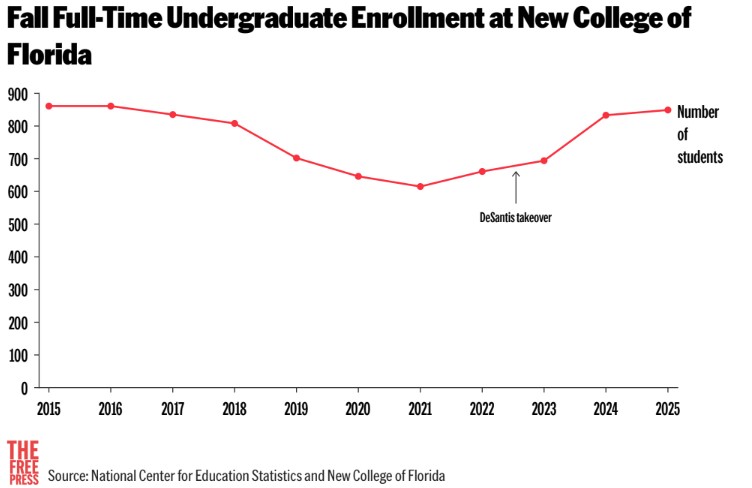
Neither version of events matches the reality I found on a recent trip to the school’s Sarasota campus, where enrollment has increased every year since 2023 and is now at more than 900 students. While there certainly are more conservative faculty members and students than before, what I saw showed that many of New College’s strongest traditions are largely untouched.
Source: National Center for Education Statistics and New College of Florida
For example, New College still relies on “narrative evaluations” of students written by their professors, though grades are now used, too, partly to satisfy graduate schools. Students still complete an independent study project before the spring semester and can participate in one-on-one tutorials with professors, though all freshmen must now take one half-semester course about Homer’s Odyssey and another about mathematics and natural sciences.
“What I’m proud about over the last three years is that in addition to many, many new ideas, new projects, new policies, new educational strategies. . . New College remains the college it was in terms of that model of experimental learning and experiential learning,” said provost David Rohrbacher, who has taught here since 2000.
The professors who spoke to me said that new president Richard Corcoran’s administration does not police what they teach, though some students said they have noticed fewer course offerings about feminism and race. “This semester, I wanted to take a class on Hannah Arendt, and they don’t offer that, so I just created it myself with this tutorial,” said Alexandra Levy, a junior. “If you wanted to take an African American literature class, you’d probably have to create a tutorial, and I don’t know who would sponsor it.”
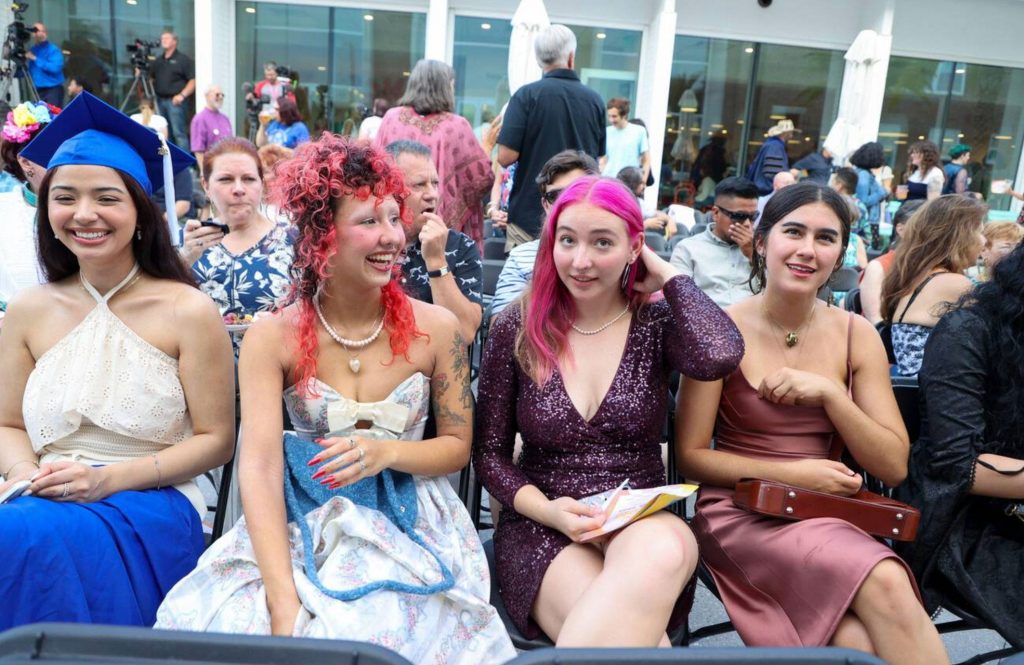
New College also hardly looks like a place being “destroyed,” as Oliver claimed. On the balmy Wednesday when I walked around the lush, palm tree–lined campus, I saw students playing pickup soccer and beach volleyball on fields overlooking Sarasota Bay. Women in elegant dresses posed for pictures with the sun setting over the Gulf of Mexico as a backdrop. Students dined and studied on the patio outside the school’s I.M. Pei–designed dorms.
DeSantis and his allies argued that New College, founded in 1960 to “free both students and faculty from the limits of lock-step curriculum,” was failing intellectually, its buildings and dorms in disrepair and badly in need of a shake-up. A 2019 report commissioned by New College found that many admitted students associated its culture with “druggies,” “weirdos,” and political correctness. The report said that the student body as a whole had “low levels of satisfaction” with New College and that “a high percentage” had “considered leaving the college before graduation.”
The pronouncement by DeSantis’s chief of staff that New College should become “Florida’s classical college, more along the lines of a Hillsdale of the South,” caused panic among those who wanted to keep New College just as it was. Over 40 percent of its 105 faculty members left by the fall of 2023, though the college says that about three-quarters of the departures were previously planned retirements or sabbaticals. At least a dozen more left within the next year. Since then, New College has hired about 45 new professors, many from elite institutions, increasing the overall size of its faculty to 125.
“Most of the ideological warriors have left,” Corcoran told me. “They’ve left because they don’t want balance. . . . The people we’ve been hiring are a who’s who of faculty in the history of the college.”
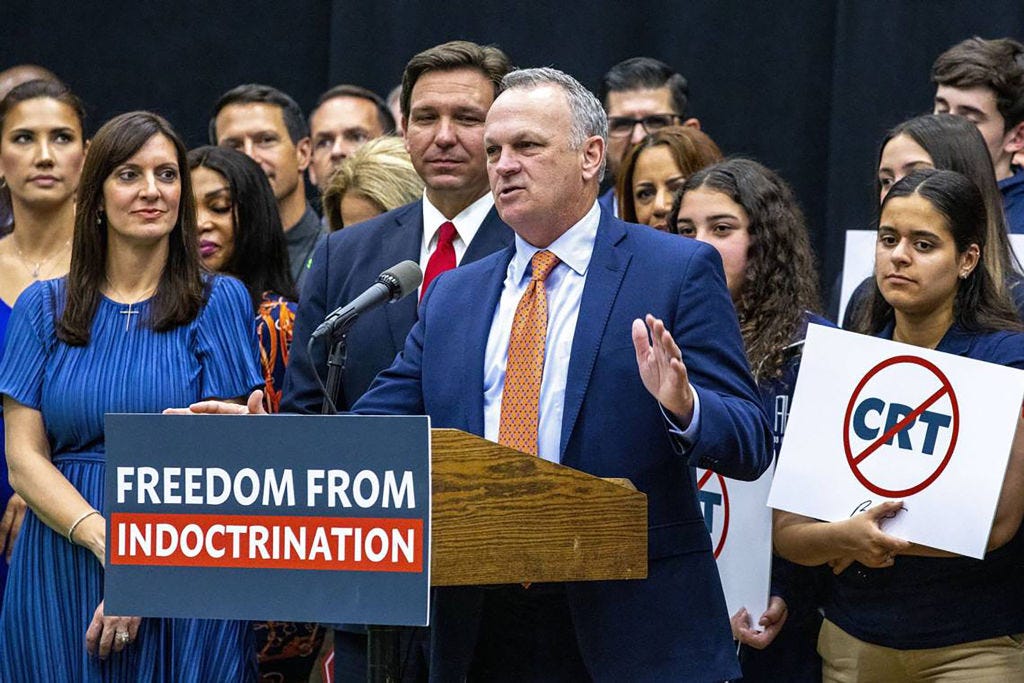
Corcoran, the Republican former speaker of the Florida House of Representatives and state education commissioner, also insisted that the Hillsdale comparison was solely about emulating its free speech, civil discourse, and selectivity in admissions, not about turning New College explicitly conservative and Christian. “The great liberal-arts schools that are not indoctrinating, that have great [test] scores and get great students—yeah, that would be who we’d like to be,” he said.
The new New College has broadened its offerings of Great Books–based courses called “Enduring Human Questions” to fulfill a new state requirement for public colleges that includes teaching the Western canon. It also commissioned a statue of Charlie Kirk, which Corcoran denied is about politics and said symbolizes the commitment to “free speech, academic freedom, and civil discourse.” And it shut down the gender-studies center and threw away some of its books.
Students can no longer earn a degree in gender studies because “it’s not a real discipline,” Corcoran said, adding that the subject “should be taught” in other classes as a component of intellectual history.
When I asked if he believes balance means equal percentages of Republicans and Democrats, Corcoran said no. “In an ideal world, it wouldn’t matter, because whoever you hired was going to teach the heck out of their discipline and not indoctrinate.” Faculty job interviews do not include questions about politics, Corcoran told me, but he makes sure that potential hires aren’t “anti–free speech” and “anti–academic freedom.”
David Mikics, an English professor who arrived in 2024 from the University of Houston, said that New College is not hiring people “who want to turn the classroom into a place for political activism” and that “people who are more leftist ideology–driven probably wouldn’t be applying here in any case.”
The overhaul has been expensive. Operating expenses at New College were over $83,000 per student in fiscal 2024, the highest of any public college or university in Florida and nearly four times the average. The high costs include renovations and new facilities across the campus—an “apocalyptic sandlot” when Corcoran arrived, he said—ranging from a baseball stadium to temporary housing after a mold infestation took out freshmen dorms.
Over 25 percent of the student body chose not to return for the fall semester in 2023. About three dozen accepted a transfer offer from Hampshire College, a freewheeling liberal-arts college in Massachusetts. Hampshire announced in April that it will close its doors when this fall’s semester ends.
Some of the liberal students who stayed at New College said they feel like the supposed political divide on campus has been exaggerated by the media. No student substantiated the narrative that the college is in the grip of a right-wing censorship apparatus, though there were complaints about a crackdown on “balcony culture.”
Students used to hang flags and posters from dorm balconies and windows, but the new administration said it posed a fire hazard. Drawing with chalk on a pedestrian overpass also was prohibited. And editors of a campus newspaper and literary magazine told me that they began to publish independently because they believed that the administration wanted to oversee them.
“We don’t censor anything,” Corcoran said in response, denying that there is or ever will be a policy policing what students publish. New College has always required oversight by faculty advisers for student clubs, including publications, he added, saying that he hoped those advisers would “teach them proper journalism” that is “fair and balanced.”
The most divisive change at New College is an influx of over 400 student athletes, many of them recruited and awarded scholarships to play on one of more than 15 varsity sports teams, which the college never had before. The move is part of a strategy to broaden racial and gender diversity on campus, not to pad enrollment.
The athletes are easy to spot in clothes branded with the school’s new mascot, the Mighty Banyan, a tree flexing its muscles. It replaced the Null Set, which was based on a mathematical notation and symbolic of New College’s proud quirkiness. Even the new mascot was controversial, with a retired teacher writing in the Sarasota Herald-Tribune that the tree “has been anthropomorphized to resemble an angry, threatening brown individual.”
Other students told me academic rigor has slipped now that there are almost as many athletes on campus as nonathletes.
“It’s like I’m back in middle school,” said Dania Hefley, a senior. “The biggest change is that I can notice students don’t want to be here, students don’t want to learn.” According to Rohrbacher, the provost, recruited athletes have had higher grade point averages than other admitted students every year since the takeover, including 2023.
“I think maybe that’s a culture shock to some of the previous students on campus,” said Jackson Dawson, a junior on the basketball team who also leads the 100-student Turning Point USA chapter. “But they’re okay with us. We all get along. We sit in the same lunch cafeteria. It’s not like there’s. . . a border wall between us.”
“Every year, it gets better and better,” Dawson added.
Minh Huynh, another senior, said it has become less common for conservative students to be ostracized for their views because there are a lot more of those students. In the past, they “would realize they don’t really have any place at the school,” Huynh said.
In October, New College said it wanted to be the first college or university to sign the Trump administration’s “Compact for Academic Excellence in Higher Education,” which promises preferential treatment for federal funding in exchange for eliminating “discriminatory admissions processes,” freezing tuition for American students, and ensuring “rigorous, good faith, empirical assessment of a broad spectrum of viewpoints,” among other requirements. Some major colleges denounced the proposal as an unlawful and unconstitutional infringement on speech and academic freedom.
It was another sign of how much New College has changed. So was last month’s commencement ceremony, where one speaker invoked Ronald Reagan, freedom, and the Constitution before telling graduates: “Protect liberty. Defend open inquiry. Respect the dignity of others.”
During my visit, I asked Corcoran if he believed there is still a place in higher education for students who want the old New College, an ideological and educational experiment that endured for over 60 years. “One hundred percent,” he said. “But not with public tax dollars. You want to use public tax dollars, it should appeal to the masses.”
Note: This article was originally posted by The Free Press, and the original can be found by visiting their website here: https://www.thefp.com/p/new-college-florida-desantis-higher-education
Jonas Du
Jonas Du is a fellow at The Free Press based in Washington, D.C. Jonas began at The Free Press in 2024 as an intern while he was a student at Columbia University, where he was founder and editor-in-chief of the Columbia Sundial.